


Table of Contents
- What Causes Fabric Pilling
- Understanding the 80/20 Blend: What Premium Means
- Does Cotton-Polyester Blend Pill
- What Causes Fabric Pilling in 80/20 Materials
- How to Prevent Pilling on Sweatshirts
- How to Wash Cotton-Polyester Clothes Properly
- How to Identify Premium Fabrics Before Buying
- Frequently Asked Questions
Last Updated: October 18, 2026
What Causes Fabric Pilling
Understanding why premium 80 20 fabric resists pilling starts with how loose surface fibers tangle into small balls through everyday wear and friction.
Pills develop when fibers break loose from the yarn structure.
Construction matters: a tight weave or compact knit holds fibers in place better than a loose one, so dense fabrics shed fewer fibers to begin with.
How Friction and Abrasion Create Pills
Every time your garment rubs against skin, a bag strap, or a car seat, abrasion weakens fiber bonds and pulls loose fibers to the surface.
Washing and drying intensify this: tumbling in a dryer creates friction from all directions, speeding pill formation.
Frequent travel accelerates pilling through constant friction from luggage, airplane seats, and repeated packing, while wearing the same piece multiple days concentrates wear in high-friction zones like underarms and seams.
Why Fiber Strength Matters
Strong fibers resist snapping when rubbed; weak fibers snap easily and shed loose ends that tangle into pills.
Long staple fibers interlock more effectively and resist dislodging; short fibers pack loosely and break apart faster.
Fiber type matters too: natural fibers like cotton have different strength properties than synthetics like polyester, which is why an 80/20 blend behaves differently from either alone.
Understanding the 80/20 Blend: What Premium Means
Premium means long-staple cotton, which is stronger and smoother and creates a more durable, pill-resistant yarn, while polyester adds reinforcement without compromising softness.
This combination is why why premium 80 20 fabric resists pilling better than cheaper blends. The cotton provides comfort and breathability. The polyester provides structure and durability.
The Role of Cotton in Blended Fabric
Cotton brings softness and breathability, but pure cotton sheds short fibers easily, so 100% cotton loungewear often pills after a few washes.
In a blend, polyester wraps around cotton fibers and holds them in place, reducing shedding so the fabric feels like cotton but performs like a durable synthetic.
Premium cotton uses long fibers that shed less; budget cotton uses short fibers that pill readily.
Why Polyester Reinforces the Blend
Polyester is strong and resists breakage under friction, and in a blend it wraps around cotton fibers like a protective layer.
This reinforcement prevents the fiber migration that causes pilling, holding the yarn tight so loose fibers can't reach the surface.
Polyester also resists abrasion better than cotton and won't snap as easily during washing or wear.
Does Cotton-Polyester Blend Pill
Yes, any cotton-polyester blend can pill, including an 80/20 blend. Fiber length, yarn twist, fabric density, finishing, and care separate a blend that stays smooth for years from one that fuzzes up after a few washes.
Why the Blend Ratio Alone Doesn't Decide Pilling
An 80/20 blend means 80% cotton and 20% polyester by weight, the recipe, not the quality of the ingredients. Two 80/20 fabrics can behave completely differently:
- One uses long-staple combed cotton, high-tenacity polyester, tightly twisted yarn, and a dense compact knit. It sheds few fibers and resists pilling.
- The other uses short-staple cotton, lower-grade polyester, loosely twisted yarn, and an open knit. It sheds fibers readily and pills within a handful of washes.
The percentage is the same; the performance is not, which is why "premium" must be defined by fiber and construction specs, not the label ratio.
The Mechanisms That Favor an 80/20 Blend
When the inputs are good, the blend has real advantages over either fiber alone:
- Long-staple cotton resists shedding. Longer fibers interlock in the yarn and are harder to pull to the surface. Short fibers are the raw material of pills.
- Polyester adds tensile strength and abrasion resistance. It doesn't snap as readily under friction, so it helps anchor the yarn structure during washing and wear.
- The blend balances moisture and strength. Cotton contributes breathability and softness; polyester contributes durability and shape retention. A well-made blend can outlast pure cotton in surface appearance.
The Limits and Exceptions
No blend is pill-proof, and several factors can outweigh a good ratio:
- Short-staple cotton in a "premium" label. If the cotton is short-staple, the fabric will shed regardless of the 80/20 ratio.
- Loose yarn twist and open knits. These give fibers room to work loose, even with good raw materials.
- Aggressive finishing. Some finishes improve hand-feel but weaken the fiber surface, increasing fuzzing.
A well-constructed 80/20 garment with long-staple cotton and a dense knit should show minimal pilling through normal wear, while a budget 80/20 with short fibers and an open knit may pill within a few washes.
How to Tell Which Kind You Have
Look for exact fiber percentages, long-staple or combed cotton, fabric weight in GSM, and pilling test results on the 1-to-5 scale. A brand citing a rating of 4 or 5 after a defined number of test cycles is making a verifiable claim; one that says only "premium" is not.
What Causes Fabric Pilling in 80/20 Materials
Even premium 80/20 fabric can pill if you treat it wrong. The most common cause is improper washing and drying.
Low-quality construction is another cause: short-staple cotton or loose weaves make these "80/20" blends pill almost immediately.
A third cause is fiber migration: even premium fabrics can pill as fibers work to the surface, faster with frequent wear and washing.
How to Prevent Pilling on Sweatshirts
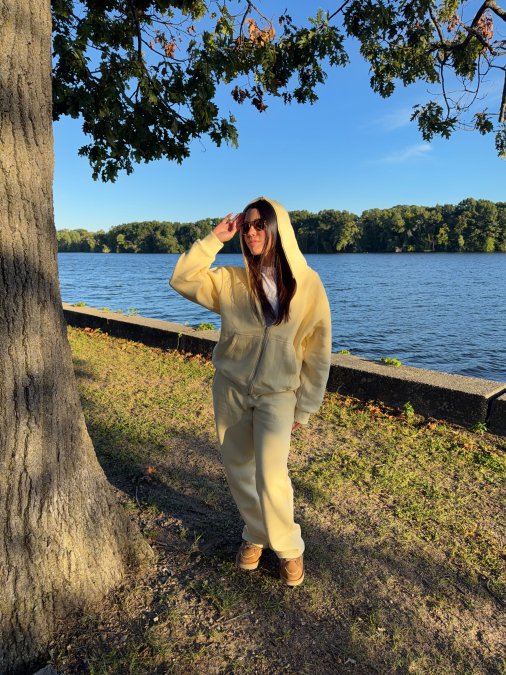
Preventing pilling starts with how you wash and dry your garments. Gentle care extends the life of any fabric, especially loungewear you wear frequently.
Washing Techniques That Reduce Friction
Wash your sweatshirt inside out to protect the outer surface from friction against other garments.
Use cold water and a gentle cycle.
Wash with similar colors and textures.
Don't overload the washer. Crowded drums create friction as garments rub together; leave space so your sweatshirt moves gently rather than getting compressed.
Drying and Storage Best Practices
Air drying is ideal for any premium fabric.
If you must use a dryer, use the lowest heat setting and remove the garment while slightly damp to finish air drying.
Store your sweatshirt folded, not hanging, since hanging stretches the fabric and can cause fibers to migrate.
How to Wash Cotton-Polyester Clothes Properly
Proper washing is the single most important factor in preventing pilling.
Temperature and Cycle Settings
Use cold water for cotton-polyester blends. Cold water preserves fiber strength and prevents shrinkage; hot water opens the fiber structure and increases pilling.
Select a gentle or delicate cycle.
Wash on a shorter cycle when possible. Extended wash times mean more friction and looser fibers; fifteen to twenty minutes is usually sufficient for lightly soiled garments.
Detergent Selection and Load Size
Use a mild detergent formulated for delicate fabrics. Harsh detergents damage fiber structure; gentle formulas clean effectively without weakening the yarn.
Add less detergent than you think you need.
Never overload the washer. A full load means garments can't move freely and rub against each other constantly; wash in smaller batches.
| Washing Factor | Best Practice | Why It Matters |
|---|---|---|
| Water temperature | Cold | Preserves fiber strength |
| Wash cycle | Gentle or delicate | Reduces friction and agitation |
| Cycle duration | 15-20 minutes | Minimizes fiber stress |
| Detergent type | Mild, delicate formula | Protects fiber structure |
| Load size | Half to three-quarters full | Allows free movement |
| Drying method | Air dry preferred | Eliminates heat damage |
How to Identify Premium Fabrics Before Buying
Product photos and marketing copy won't tell you whether an 80/20 garment will pill. You need measurable signals, the checks below give you something concrete to compare across products.
Read the Fiber Label Like a Spec Sheet
The label must state exact percentages, for example, 80% cotton and 20% polyester. A label saying only "cotton blend" or "poly-cotton" is a red flag because you can't confirm the ratio. Also check for fiber descriptors: long-staple or combed cotton signals raw material selected to reduce short-fiber shedding, since combing removes short fibers that feed pills.
Check Fabric Weight and Density
Fabric weight is usually expressed in grams per square meter (GSM) or ounces per square yard. Heavier, denser knits hold fibers in place better than thin, open ones. Ask the seller for the GSM if it isn't listed, a legitimate manufacturer knows it. In person, hold the fabric up to light: if you can see a lot through it, the knit is open and fibers have room to migrate.
Look for Pilling and Abrasion Test Results
This is the check almost no shopper performs, and it separates real claims from marketing. Two standardized laboratory methods dominate:
- Martindale abrasion test (ASTM D4966): A specimen is rubbed against an abrasive surface in a repeating pattern. Results are reported as the number of cycles the fabric withstands before a defined level of wear or pilling appears. Higher cycle counts mean better abrasion resistance.
- Random tumble pilling test (ASTM D3512): Fabric samples tumble in a lined cylinder with a small amount of abrasive material, simulating the friction of washing and wear. Samples are then rated on a visual scale.
Pilling is typically graded on a 1-to-5 scale, where 5 means no pilling and 1 means severe pilling. A fabric rated 4 or 5 after a defined number of test cycles is genuinely pill-resistant; a 2 or 3 will show visible pills in normal use.
Ask About Yarn and Construction Specifics
Fiber length and yarn twist most affect pilling. Long-staple cotton (typically 1.25 inches or longer) creates stronger yarns with fewer loose ends, and tightly twisted yarns lock fibers in place while loose ones shed. Ask whether the cotton is long-staple or combed and whether the fabric is a compact knit or tightly woven; reputable manufacturers can answer because they specify these in production.
Use the Return Policy as a Test
A generous return window is a practical proxy for confidence. If a brand accepts returns after the garment has been washed and worn a few times, it is betting its own money that the fabric won't pill; a short window excluding washed items tells you the opposite.
Frequently Asked Questions
Does an 80/20 cotton-polyester blend pill?
An 80/20 blend resists pilling better than many alternatives, but it can still pill under certain conditions. The 80% cotton provides softness and breathability, while the 20% polyester reinforces fibers and improves durability. Premium versions use long staple fibers and tight fabric construction to minimize pilling. However, aggressive washing, low-quality yarn, or loose fabric weaves can still cause pills to form. Proper care, washing inside out on a gentle cycle, significantly reduces pilling risk in 80/20 fabrics.
What fabric is most resistant to pilling?
Fabrics with long staple fibers, high fabric density, and strong fiber construction resist pilling best. Premium 80/20 cotton-polyester blends rank highly because polyester fibers are inherently stronger and less prone to breakage than pure cotton. Tightly woven fabrics and compact knit constructions also resist pilling by reducing loose fiber ends. Synthetic blends like nylon-polyester perform well too, though they lack the breathability of cotton-polyester. The quality of yarn, fiber length, and fabric weight matter more than fiber type alone.
How can I prevent my sweatshirt from pilling?
Wash inside out on a gentle or delicate cycle with cold water to reduce friction and abrasion. Use a mild detergent, avoid overloading the machine, and skip the dryer when possible, air dry instead to minimize mechanical stress. Remove pills carefully with a fabric shaver or lint roller rather than picking them off, which can damage fibers. Store sweatshirts folded rather than hanging to reduce stretching and stress on fibers. Choosing premium fabrics with high fiber strength and tight construction provides a foundation, but proper care is essential for long-term pilling resistance.
Does pilling mean low quality?
Pilling doesn't automatically indicate low quality, even premium fabrics can pill under harsh conditions or aggressive wear. However, high-quality fabrics pill less frequently and less noticeably because they use long staple fibers, strong yarn, and tight construction that resists fiber breakage and migration. Low-quality fabrics often use short fibers and loose weaves that shed fibers easily, resulting in excessive pilling. The key is that premium 80/20 blends are engineered to minimize pilling through superior fiber strength and fabric density, making them more durable over time with proper care.
Pilling doesn't have to be inevitable. When you choose why premium 80 20 fabric and care for it properly, your loungewear stays smooth and beautiful for years. The combination of long fibers, reinforced blends, and tight construction creates fabric that resists pilling where cheaper alternatives fail. Invest in quality, wash gently, and your favorite pieces will keep delivering comfort and confidence.


