


Last Updated: October 28, 2026
Quick Summary
Flattering oversized loungewear keeps one part of the outfit close to the body, usually the waist or a fitted top, so the volume reads as intentional. Check that the fabric skims without clinging or tenting, and choose heavier fleece that holds its shape. A dropped shoulder and a defined waist are the quickest fixes for a shapeless look.
- Keep one piece fitted or structured, such as a slim ribbed tank or a waistband at the natural waist.
- Raise your arms in the mirror: the hem should lift slightly but not ride up to your ribs.
- Heavier fleece holds its shape and skims well, while thin jersey can cling in the wrong places.
- Wash inside out on a gentle cycle in cold water to keep the fit longer.
- Write your three measurements down and compare them to the garment's listed measurements before buying.
Table of Contents
- Why Oversized Loungewear Can Look Shapeless (and How to Fix It)
- How Oversized Loungewear Should Fit: The Skim-Not-Cling Test
- Flattering Loungewear for Different Body Types
- Best Fabric for Loungewear: How to Judge Drape, Weight and Construction
- How to Style Oversized Sweatshirts Without Looking Shapeless
- How to Wear Matching Loungewear Sets Out of the House
- Choosing Your First Oversized Set From Happy Girl Edit & Co.
- Frequently Asked Questions
Why Oversized Loungewear Can Look Shapeless (and How to Fix It)
Oversized loungewear can look great on the hanger but shapeless on the body. The fix is often a matter of proportion, fabric and where the volume sits.
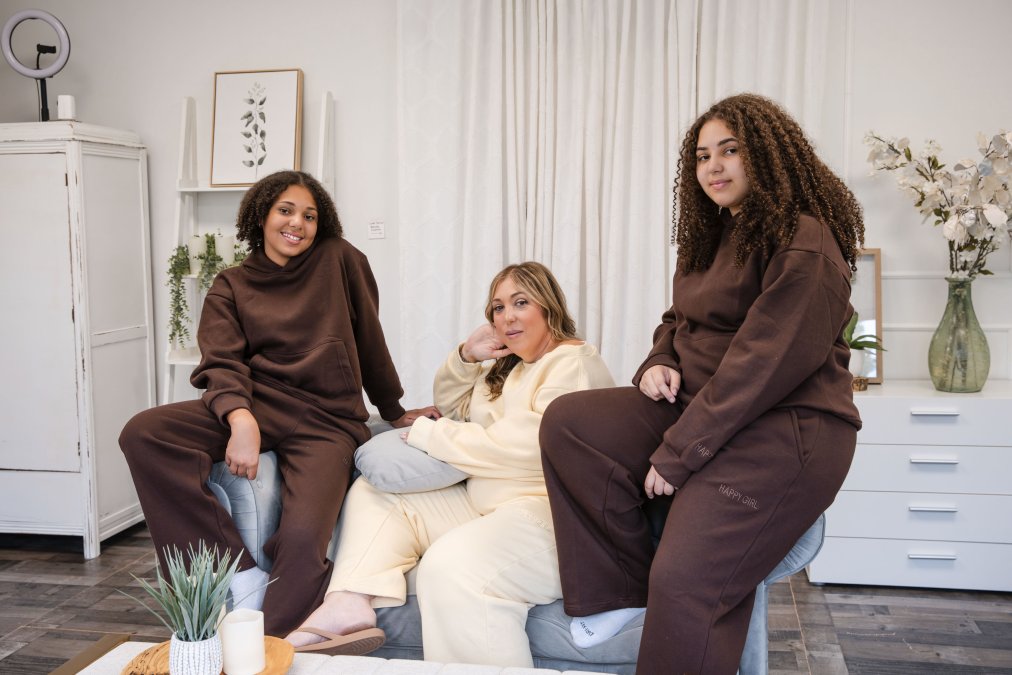
Shapelessness happens when the whole outfit is the same width from top to bottom. A wide sweatshirt over wide pants leaves no line anywhere, so the eye slides off the body. Oversized pieces look intentional when one part of the outfit stays closer to the body and gives the eye a place to rest.
Here is how to break up the volume:
- Keep one piece fitted or structured. A slim ribbed tank or a waistband that sits at the natural waist does this job.
- Define the waist. Tuck the front of a sweatshirt or add a belt over loose fleece.
- Mix volume with lean. Pair a roomy top with slim joggers, or wide pants with a shorter, cropped top.
- Check the shoulders. A dropped shoulder reads as relaxed. A shoulder that hangs past the arm looks like the garment is wearing you.
A common mistake is buying every piece in the same oversized cut. Keep the look relaxed, but leave one anchor point so the outfit has structure.
How Oversized Loungewear Should Fit: The Skim-Not-Cling Test
Oversized does not mean baggy everywhere. The best test is simple: the fabric should skim the body without clinging to it and without hanging off it in a tent shape.
Try this check in the mirror:
- Raise your arms. The hem should lift slightly but not ride up to your ribs.
- Look at the shoulder seam. It should land near the edge of your shoulder, a little lower is fine.
- Look at the sleeve length. Fleece sleeves can sit at the wrist or just past it. Anything that covers your hands completely is too long for most styling.
- Pinch the fabric at the side. You should have a small amount of ease, roughly a hand's width, not a fistful.
Heavier fleece holds its shape and skims well. Thin jersey can cling in the wrong places, so check how the fabric falls when you move, not just when you stand still.
Sizing matters here. Compare the measurements in the size guide with a piece you already own that fits the way you like before you choose.
Flattering Loungewear for Different Body Types
Most body-type advice stops at labels. A more reliable method is to work from three measurements and one proportion rule, then adjust for height. The measurements are your shoulder width, your natural waist, and your inseam.
Take the measurements once, write them down, and compare them to the garment measurements on the product page. A relaxed-fit sweatshirt typically lists a chest width and a body length; a relaxed sweatpant lists a waist range and an inseam. If your shoulder width is, say, 16 inches and the sweatshirt's shoulder-to-shoulder is 22 inches, you are looking at a 6-inch drop, a true oversized cut.
Petite frames (under about 5'4"). The problem is rarely width; it is length. A sweatshirt body length over about 24 inches will swallow the torso and shorten the legs. Look for cropped or hip-length tops (22 to 24 inches), a rise that sits at or just below the natural waist, and an inseam that ends at or above the ankle bone so you can see footwear.
Taller frames (about 5'8" and up). You can carry more volume, but the risk is a look that reads as one long column. Use a longer hemline (26 inches or more on a top) over a slimmer or mid-rise bottom, and let the sleeve end at the wrist rather than past it.
Curvy and plus-size frames. The reliable move is relaxed on top, defined at the waist, and a bottom that follows the leg rather than ballooning away from it. Choose a top with a body length that ends at the high hip, long enough to cover the waistband, short enough not to add length to the torso. A front tuck, a tie, or a wide waistband creates the waist line.
Straight or athletic frames. You are adding dimension, not reducing it. Volume at the shoulder (a dropped shoulder or an off-the-shoulder neckline) or at the hip (a wide-leg pant) creates the curve the frame does not supply on its own. Keep one area close to the body so the added volume reads as a choice.
Whatever your frame, the goal stays the same: one clear shape, one defined area, and fabric that moves with you. The measurements just tell you where to place them.
Best Fabric for Loungewear: How to Judge Drape, Weight and Construction
Fabric decides whether an oversized piece looks relaxed or rumpled. You can judge it in the store or from the product page using four checks: weight, drape, stretch recovery, and construction. Each has a concrete test.
Weight. Fabric weight is usually listed in ounces per square yard (oz/yd²) or grams per square meter (GSM). As a rough guide, lightweight jersey sits around 4 to 5 oz/yd², midweight fleece around 8 to 10 oz/yd², and heavyweight fleece around 11 to 14 oz/yd². Heavier fabric holds a shape and stands away from the body, which is what makes an oversized cut look intentional.
Drape. Drape is how the fabric falls under its own weight. Hold the garment by the shoulders and watch the body. Good drape flows in soft, even folds with no sharp angles. Stiff fabric stands out in planes and makes the silhouette boxy. A quick test: pinch a section of the fabric between thumb and forefinger and release it.
Women's Off-the-Shoulder Sweatshirt – Cream →
Stretch recovery. Loungewear needs some stretch, but recovery matters more than stretch. Pull a cuff or a waistband to about 10 percent beyond its resting length, hold for a few seconds, and release. It should return close to its original size. Slow recovery means the piece will bag at the knees, elbows, and seat by mid-afternoon.
Construction. Check the seams, cuffs, and hem. Ribbed cuffs and a ribbed hem keep an oversized top from flaring at the ends and are one of the clearest signals of a well-made piece. Run a finger along the inside seam: flat, even stitching with no loose threads or puckering holds up to washing. Check that the neckline keeps its shape after you pull it on, a neckline that stretches out immediately will not recover.
Happy Girl Edit & Co. offers pieces made from premium 80/20 cotton blend fleece with an ultra-soft brushed interior. When you shop, read the fabric content and compare it to the four checks above.
Judge the fabric before you buy.
Four checks let you judge an oversized piece's fabric before you buy, with a rough weight guide for each fabric type.
| Check | What to look for | Why it matters |
|---|---|---|
| Weight (oz/yd²) | Jersey 4-5, fleece 8-10, heavy fleece 11-14 | Heavier fabric stands away from the body |
| Drape | Soft, even folds that flow | Stiff fabric makes the silhouette boxy |
| Stretch recovery | Returns close to original size after 10% pull | Slow recovery causes bagging |
| Elastane content | Commonly 2-5% | Helps fabric recover its shape |
| Ribbed cuffs and hem | Present on the garment | Stops oversized tops from flaring |
| Care | Wash inside out, cold, low heat | Heat is the main cause of shrinkage and pilling |
How to Style Oversized Sweatshirts Without Looking Shapeless
Pair the oversized top with one element that gives the outfit a clear line.
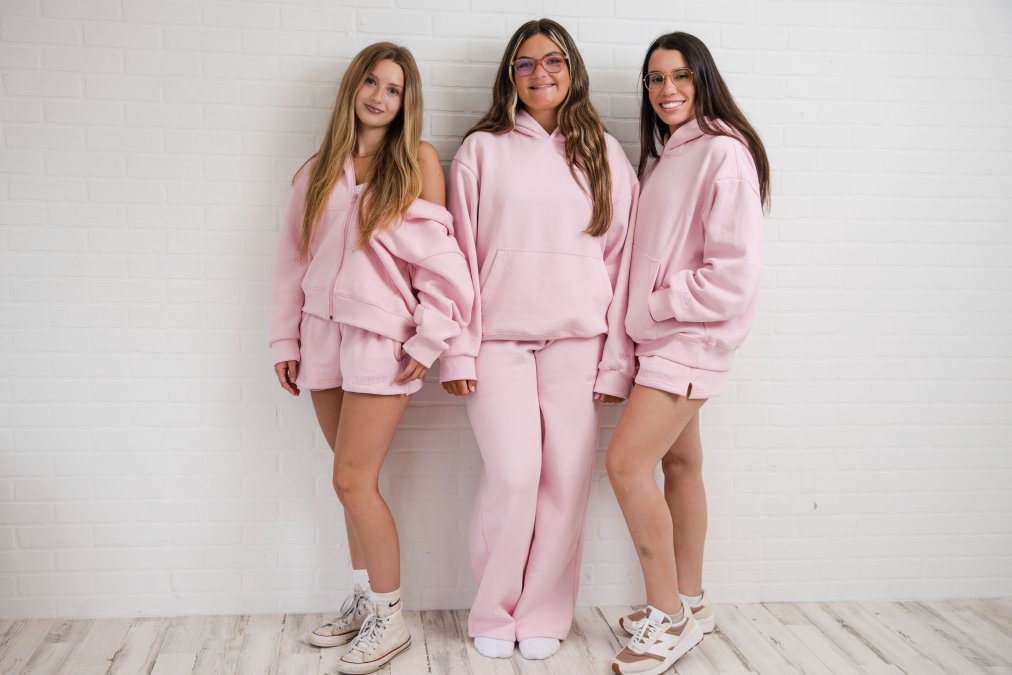

Try these three formulas:
- Tucked front, relaxed back. Tuck only the front of the sweatshirt into high-waisted pants. The waist is defined and the back still drapes.
- Sweatshirt and slim bottom. Pair the oversized top with slim joggers or leggings so the volume stays on top.
- Belted layer. Add a thin belt at the natural waist over an oversized crewneck or hoodie for a shape that works for errands.
Keep accessories simple. A clean sneaker, a crossbody bag and a small pair of earrings let the fabric and fit do the talking.
How to Wear Matching Loungewear Sets Out of the House
A matching set is the easiest way to look put together, because the coordination is already done for you. The challenge is making the set look like an outfit rather than pajamas.
Start with fit. The top and bottoms should match in their level of volume. If the sweatshirt is relaxed, the pants should be relaxed too, but not so wide that the whole look becomes one shapeless block.
Then add one or two structured pieces:
- A structured tote or a crossbody bag
- Clean white or neutral sneakers
- A simple gold or silver accessory
- A longline coat or jacket for cooler days
For errands, a set with a bit of structure reads as deliberate. For a day at home, you can lean into full comfort. Matching sets work well in airports too, because the coordinated look reads as dressed rather than sleepy when the shoes and bag are right.
Choosing Your First Oversized Set From Happy Girl Edit & Co.
If you are starting out, a few practical steps help you choose well. Browse the Specialty Happy Girl Crewneck to see one of the brand's oversized pieces up close.
-
Pick the piece you will wear most. If you want an everyday top, start with the Happy Girl Pullover Hoodie in cream. It is designed for layering or wearing alone, and it pairs with sweats, jeans or biker shorts.
-
Consider the full set. The Women's Sweatshirt & Sweatpants Set in cream pairs an off-the-shoulder sweatshirt with matching sweatpants, both made from premium heavyweight 80/20 cotton blend fleece. You can also see the matching Specialty Happy Girl Crewneck Sweatpants to complete the look.
Find the pieces that fit your routine and start with the ones you will reach for most.
Frequently Asked Questions
How do you make oversized loungewear look flattering?
Balance volume with structure. Pair a relaxed top with a defined bottom, such as a tucked sweatshirt over fitted leggings or a cropped hoodie with straight-leg lounge pants. Choose pieces with ribbed cuffs and hems, which hold shape and keep the outfit from looking like one shapeless mass. Look for a drape that skims the body rather than hanging straight from the shoulders, and roll sleeves or adjust the waistband to show where your body narrows. These small choices keep an oversized silhouette looking intentional.
How should oversized loungewear fit?
Oversized loungewear should feel loose through the body without billowing. Shoulder seams should sit near the natural shoulder or slightly below it, and the hem should land at a consistent point rather than pooling. Check that the fabric skims your silhouette instead of clinging or hanging like a tent. Sweatshirts should be roomy at the chest but not so wide that the armholes drop. Sweatpants should have a waistband that stays put without digging in.
Can petite people wear oversized loungewear?
Yes, but proportion matters more than size. Petite frames look best in oversized pieces when the fit is balanced with a defined waist, such as tucking the top or cinching with a belt or scrunchie. Shorter lengths on sweatshirts and hoodies help avoid a swallowed look, and rolling the hems of lounge pants keeps them from overwhelming your height. Mix oversized pieces with one fitted element to keep the outline visible.


